Euclid
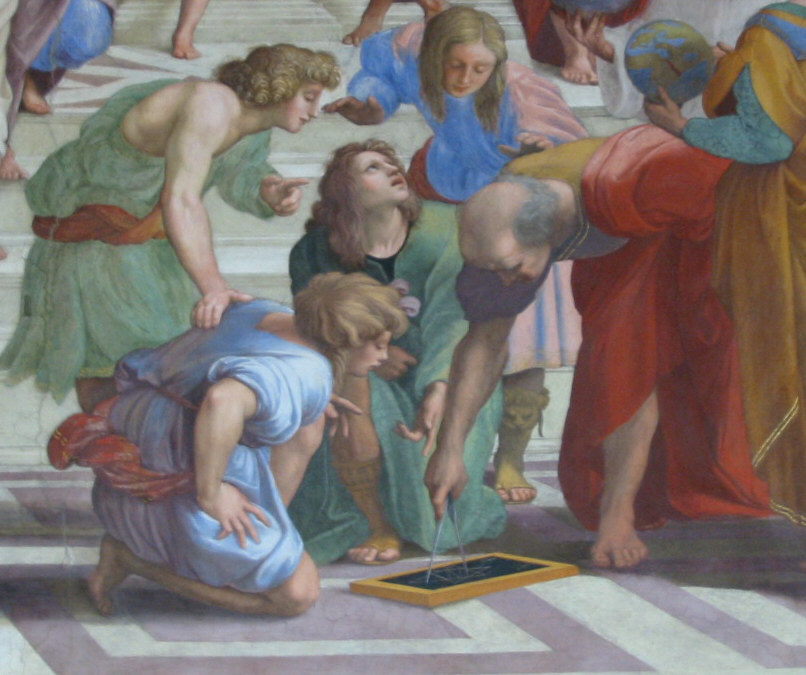
Euclid was an ancient Greek mathematician generally understood to have worked in Alexandria around 300 BCE. His Elements brought together geometry and number theory within an influential structure of proofs. Although details and precise dates of his life are unknown, the work shaped mathematical education and ideas about reasoning for centuries. He is also known as Euclid of Alexandria.
Who was Euclid?
Euclid was an ancient Greek mathematician generally understood to have been active in Alexandria around 300 BCE. His name is especially associated with the Elements. Rather than inventing geometry single-handedly, he organized and developed earlier mathematical knowledge within an influential structure of demonstrations.
Limits of the biographical evidence
His birthplace, family background, detailed education and precise death date are unknown. Approximate dates such as 325–265 BCE, found in some accounts, are not securely recorded life dates. Major biographical narratives come from much later authors. The mathematician should also be distinguished from the earlier philosopher Euclid of Megara.
Alexandria and the Ptolemies
The late ancient author Proclus places Euclid in the time of Ptolemy I. The tradition that he taught mathematics in Alexandria provides the basic setting for his career. His precise institutional position at the Library or Mouseion is not securely documented. Association with Alexandria does not establish that he was born there.
Earlier mathematical traditions
Euclid built on earlier Greek mathematics, including work associated with Eudoxus on proportions and investigations linked with Theaetetus. He should not be credited with first discovering every result in the Elements. Much of his influence arose from presenting diverse results as a connected and teachable body of knowledge.
The thirteen books of the Elements
The Elements, known in Greek as Stoicheia, consists of thirteen books. Its subjects include plane geometry, ratios, numbers, incommensurable magnitudes and solid geometry. Books XIV and XV, appended in some historical copies, do not share the authorship of the original thirteen-book collection.
Definitions, postulates and common notions
The work introduces definitions, including terms such as point and line, together with starting assumptions for demonstrations. Postulates address geometrical operations and relationships, while common notions express more general principles of reasoning. Results are justified through accepted starting points and earlier propositions rather than through the appearance of a drawing alone.
Proof and construction
In the Elements, stating that a proposition is true is insufficient: its truth must be demonstrated. Some propositions construct figures; others establish necessary relationships. Diagrams assist understanding, but measuring a length in a particular drawing does not replace a general proof.
The fifth postulate
The fifth postulate states a condition under which two lines, crossed by another line, meet on the side where the interior angles total less than two right angles. Attempts to prove it from other assumptions continued for centuries. Non-Euclidean geometries showed how alternative parallel assumptions could support different geometrical structures without invalidating Euclidean geometry within its own framework.
Triangles, circles and Pythagoras
The early books examine triangles, angles, areas and circles. Proposition I.47 establishes that the square on the hypotenuse of a right triangle equals the sum of the squares on its other sides. Written today as a² + b² = c², the result is demonstrated geometrically through areas.
Ratios and similarity
Book V develops a general theory of ratios extending beyond relationships expressible through whole numbers alone. Book VI applies this framework to similar figures and geometrical problems. Equal corresponding angles and proportional sides allow precise comparisons between figures of different sizes.
Number theory beyond geometry
Books VII, VIII and IX investigate numbers, divisibility, proportions and primes. Describing the Elements solely as a book about shapes therefore misses much of its scope. Although its conception and representation of numbers differ from modern practice, many of its problems remain fundamental to number theory.
The Euclidean algorithm
Proposition VII.2 provides a method for finding the greatest common measure of two numbers. The modern Euclidean algorithm belongs to this tradition. In its remainder-based formulation, the larger number is divided by the smaller, and the process repeats with the divisor and remainder. The last nonzero remainder is the greatest common divisor.
Infinitely many primes
Proposition IX.20 shows that there are more primes than any specified finite collection. In a modern presentation, adding one to the product of selected primes leads to a prime divisor outside that collection. The constructed number need not itself be prime. The reasoning works against every proposed finite list.
Incommensurable magnitudes
Book X classifies incommensurable magnitudes, including line segments that cannot both be measured as whole-number multiples of a common unit. These investigations connect with modern irrational numbers but should not simply be equated with today’s number system. Their geometrical language reflects the distinctive structure of ancient mathematics.
Solid geometry and regular polyhedra
The final books investigate planes, solids and volume relationships. Book XIII reaches constructions and comparisons of regular polyhedra: the tetrahedron, cube, octahedron, dodecahedron and icosahedron. The Elements thus develops a broad mathematical sequence from basic line and angle relationships to three-dimensional structures.
Other works
Works associated with Euclid include the Data, Optics and Phaenomena, which concerns geometrical astronomy. Lost writings are also known through later authors. These works extend his intellectual profile beyond elementary geometry, although questions of preservation and attribution must be assessed individually.
Manuscripts, translations and printing
The Elements circulated through Greek manuscripts and Arabic and Latin traditions of translation and commentary. D’Orville 301, copied in Constantinople in 888, is an important witness. Erhard Ratdolt published its first printed edition in Venice in 1482. Editions in many languages extended its reach across teaching and research communities.
Mathematical legacy
Euclid’s legacy includes an ideal of building knowledge through connected justifications, not merely individual theorems. The Elements shaped mathematical education for centuries, while later researchers also examined its implicit assumptions. The famous story about there being no royal shortcut to geometry is not a contemporary record. His enduring influence is best assessed through the structure of his work.