Isaac Newton
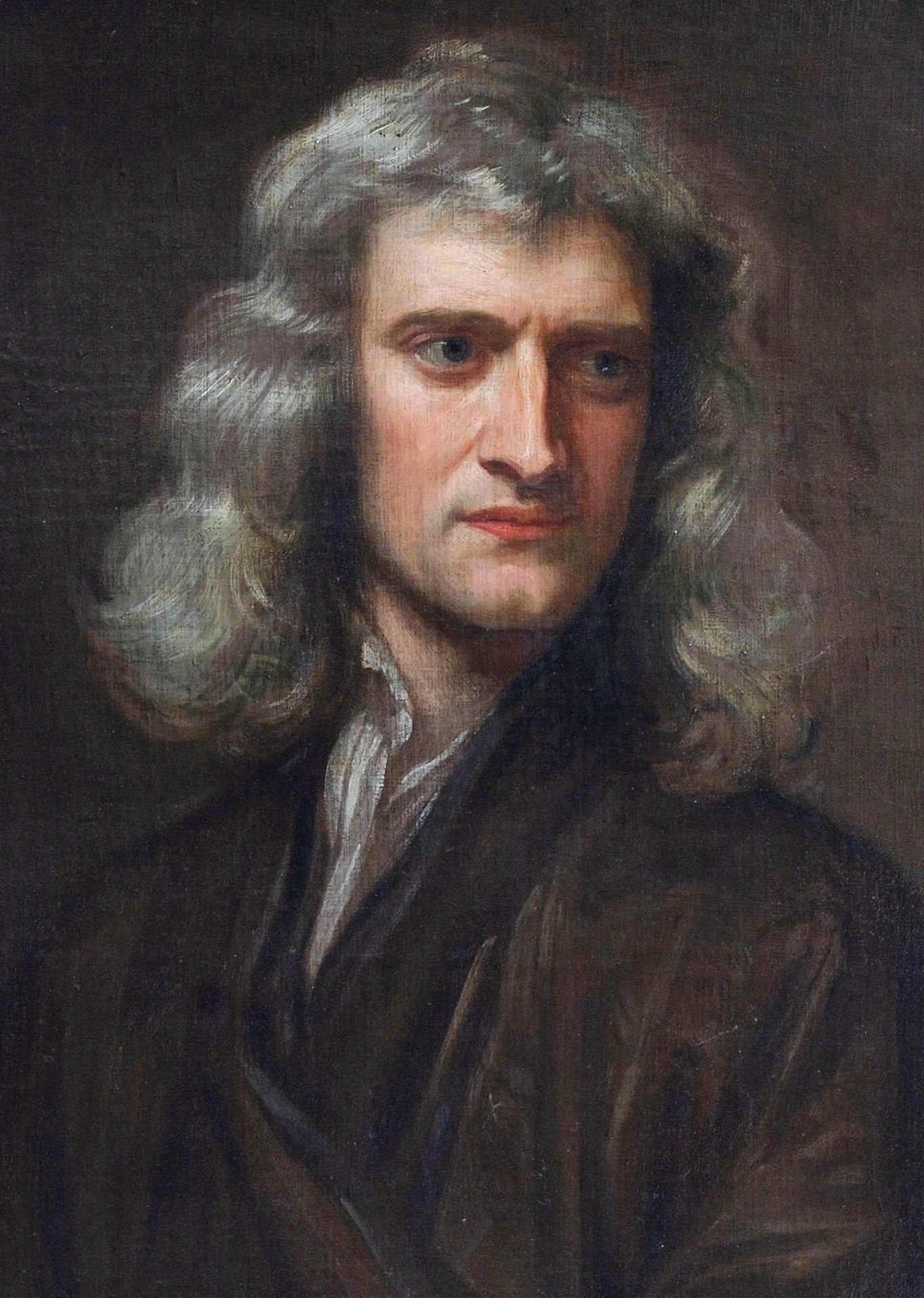
Isaac Newton was an English scientist who brought motion and gravitation into a shared mathematical framework, contributed to the development of calculus and became renowned for his experiments with light. His combination of mathematics, observation and experiment was decisive in the establishment of classical physics. His life also extended beyond scientific discoveries: public service, scientific disputes, alchemy and religious research were important parts of his intellectual world.
Birth, family and the calendar difference
Newton was born at Woolsthorpe in Lincolnshire, England. His birth fell on 25 December 1642 in the Julian calendar then used in England and on 4 January 1643 in the Gregorian calendar widely used today. This difference explains why sources give both 1642 and 1643. His father died before his birth. After his mother, Hannah Ayscough, remarried, he spent part of his childhood with his maternal grandmother. He later attended the King’s School in Grantham.
Cambridge and his turn to mathematics
He entered Trinity College, Cambridge, in 1661. Alongside the university’s traditional curriculum, he independently studied contemporary mathematics and natural philosophy. The works of Descartes, Wallis and other writers formed part of the scientific environment in which his thinking developed. He became a Fellow of Trinity in 1667 and, with Isaac Barrow’s support, was appointed Lucasian Professor of Mathematics in 1669. Cambridge remained the centre of his research and academic life for many years.
The plague years at Woolsthorpe
When plague disrupted university life in Cambridge in 1665, Newton returned to Woolsthorpe. Between 1665 and 1667, he worked intensively on mathematics, light and motion. Important elements of ideas that would later become major theories developed during this period. It would be misleading to imagine that he completed all his discoveries at once. The comprehensive formulation of universal gravitation, in particular, depended on calculations, discussions and observations continuing over the following years.
Calculus: the mathematics of change
Newton described his approach to changing quantities through fluents and fluxions. These investigations contributed to the foundations of calculus, now taught as differential and integral calculus. Differentiation examines rates of change, while integration addresses accumulation and total quantities such as areas. He also investigated infinite series and the generalized binomial expansion. These mathematical methods strengthened the study of curves and the solution of problems involving motion. Much of his work was published long after it had been developed.
The three laws of motion
The first law states that, without a net external force, an object maintains rest or uniform motion in a straight line. The second relates force to the rate of change of momentum; for constant mass, net force equals mass multiplied by acceleration. The third states that interacting objects exert forces of equal magnitude and opposite direction on one another. The forces in the third law act on different objects, so they do not cancel on the same object. These laws apply across a wide range of everyday situations and engineering calculations.
Universal gravitation
Newton treated falling objects on Earth and the motions of the Moon and planets under a common law of attraction. For two point masses, the force is proportional to the product of their masses and inversely proportional to the square of their separation. The same approach can be applied to spherically symmetric bodies under appropriate conditions. This strengthened a shared mathematical account of terrestrial and celestial motion rather than separate physical rules for Earth and the heavens. Newton calculated gravity’s effects without claiming to have fully explained its physical cause.
Principia, published in 1687
Philosophiae Naturalis Principia Mathematica, or Mathematical Principles of Natural Philosophy, appeared in 1687. It systematically united the laws of motion with gravitation, addressing problems including planetary motion, comets and tides through common principles. Edmond Halley encouraged Newton to develop the work and provided important support for its publication. Principia was more than a catalogue of results: it demonstrated a method for investigating physical events mathematically.
Prisms and white light
Newton’s prism experiments showed that white light consists of different coloured components. Rather than assuming that the prism created the colours, he argued that the components were refracted by different amounts. Recombining separated light provided experimental support for this explanation. His work on light and colour, published in 1672, provoked extensive scientific discussion. His optical research demonstrated the importance of carefully designed experiments and the testing of alternative explanations, alongside observation itself.
The reflecting telescope
The small reflecting telescope Newton constructed around 1668 was an early successful example of an instrument collecting light with a mirror rather than a lens. He intended to reduce chromatic aberration, the problem caused when different colours focus differently in lens-based systems. The instrument attracted attention at the Royal Society and helped establish his scientific reputation. The Newtonian arrangement became an important design within the development of reflecting telescopes. It also demonstrates his involvement in making experimental instruments as well as developing theories.
Opticks and questions for further research
Published in English in 1704, Opticks brought together Newton’s investigations of reflection, refraction and colour. Compared with the predominantly mathematical presentation of Principia, experiments, observations and the conclusions drawn from them occupied a more prominent place. The Queries, expanded in later editions, opened further questions about light and matter. Newton’s account of light was an important historical stage; it should not be credited retrospectively with every detail of modern theories of light.
Disputes with Leibniz and Hooke
Gottfried Wilhelm Leibniz independently developed calculus. A disagreement about priority became increasingly bitter as supporters of both men joined in. Modern accounts recognize both contributions to the development of calculus, while much of the notation now used follows the Leibnizian tradition. Newton also disagreed with Robert Hooke over ideas concerning light and gravitation. These disputes show that scientific history involves not only discoveries but also correspondence, publication decisions, institutions and personal rivalries.
The Royal Society and knighthood
Elected a Fellow of the Royal Society in 1672, Newton became its President in 1703 and held the office until his death. The presidency increased his scientific authority and institutional influence. Queen Anne knighted him in 1705, which is why he is also called Sir Isaac Newton. Alongside academic work, public responsibilities and scientific institutions became particularly prominent during the London phase of his life.
The Royal Mint and counterfeiting
Newton became Warden of the Royal Mint in 1696 and Master in 1699. His work was not merely nominal: he took a close interest in coin production, administration and monetary problems. He participated in the recoinage of silver money and investigated clipping and counterfeiting. Gathering evidence and pursuing cases against suspects formed an important part of his life beyond the laboratory and university.
Alchemy
Newton spent years reading alchemical works, making notes and conducting experiments concerning transformations of matter. Many of these studies are now investigated through his surviving manuscripts. Treating them simply as unsuccessful attempts at modern chemistry obscures their historical context. Seventeenth-century scholars studied hidden natural processes, metals and chemical changes within different traditions of knowledge. Newton’s alchemical interests show why his scientific identity needs to be understood within that broader setting.
Religion, scripture and chronology
Newton made extensive notes on the Bible, early Christian history, prophetic interpretation and the chronology of ancient civilizations. His religious thought did not align at every point with established church teaching; he developed views opposing traditional Trinitarian doctrine. He did not openly publish much of this material during his lifetime. Religious and historical studies were not insignificant diversions from his investigations of nature but intellectual fields to which he devoted sustained effort.
What the apple story actually tells us
There is testimony that Newton described a falling apple as prompting reflection on gravity. William Stukeley’s later memoir is among the familiar sources for the story. The popular image of an apple hitting his head and instantly producing the entire theory is not equivalent to the reliable historical account. The story symbolizes asking how a falling object on Earth relates to the Moon’s motion. The theory itself required prolonged mathematical work and interaction with other scientists.
Personal life, final years and death
Newton never married. He was known for intensive working habits, and different periods have produced different accounts of his personality and relationships. Describing him solely as an isolated genius can obscure his connections with family, colleagues and public institutions. During his final years in London, he retained his scientific standing and public role. He died on 20 March 1727 in the Julian calendar, equivalent to 31 March in the Gregorian calendar, and was buried in Westminster Abbey.
Legacy and the limits of Newtonian physics
Newton’s influence extends beyond solving motion problems with a few laws. His approach linking mathematical explanation with experiment and observation profoundly affected physics and engineering. His contributions to calculus, celestial mechanics and optics provided a strong foundation for later research. Relativity and quantum theory showed in the twentieth century that classical physics is not sufficient at every scale. Nevertheless, Newtonian mechanics remains extremely useful in many situations where speeds are small compared with the speed of light and quantum effects are not decisive.