Christopher Columbus
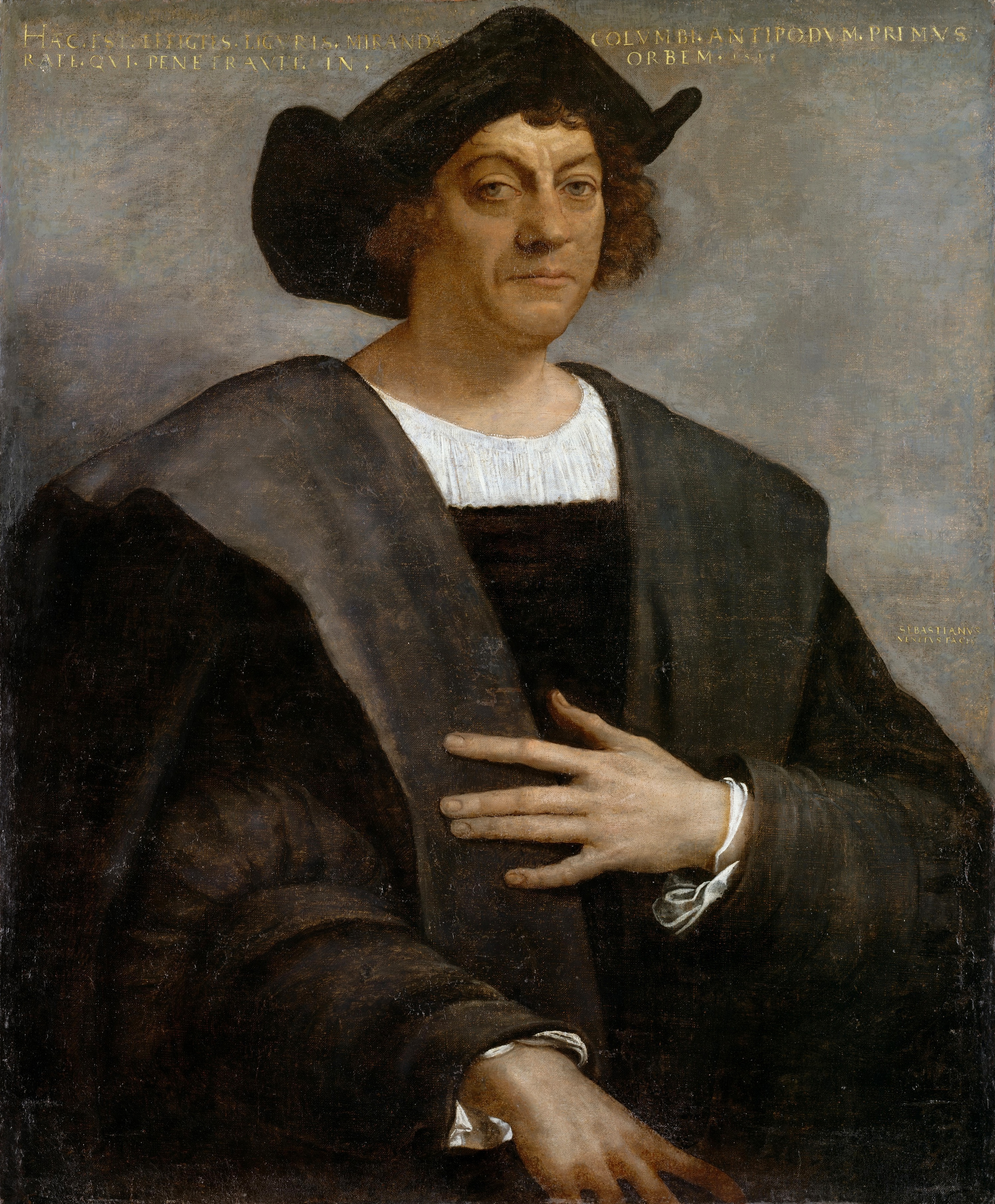
Christopher Columbus was a Genoese navigator and colonial administrator who led four Atlantic expeditions between 1492 and 1504 with support from the monarchs of Castile and Aragon. Seeking a westward route to Asia, he reached the Caribbean and subsequently the coasts of South and Central America. His voyages marked an important beginning of sustained connections between Europe and the Americas. This process was also associated with conquest, enslavement and devastating losses for Indigenous societies.
Names and historical identity
Known in English as Christopher Columbus, his name appears as Cristoforo Colombo in Italian and Cristóbal Colón in Spanish. There was no unified state corresponding to modern Italy in his lifetime, so identifying him through his origins in the Republic of Genoa provides useful historical context. Columbus was more than a navigator: he asserted possession in the monarchs’ names and exercised colonial authority. His maritime abilities need to be considered together with his political and economic objectives.
Birth in Genoa and early life
The prevailing historical view places Columbus’s birth in the Republic of Genoa in 1451. His exact birthday is unknown. His parents are recorded as Domenico Colombo and Susanna Fontanarossa. His father’s connection with wool working situates the family within a world of crafts and trade. Columbus developed maritime interests and gained experience in the Mediterranean. Details of his childhood and earliest education are not all equally documented. Later legends surrounding his fame should be distinguished from firmer evidence.
Portugal and Atlantic experience
Columbus lived for a time in Portugal before his major expedition. Atlantic seafaring and geographical discussions provided an environment in which his westward project developed. Practical experience and reading informed one another. He failed to secure the support he sought from the Portuguese monarchy and subsequently approached other Iberian court circles. This period shows that the voyage of 1492 was not an abrupt decision but an undertaking requiring a prolonged search for sponsorship and resources.
The plan to reach Asia from the west
Columbus intended to cross the Atlantic westwards to reach Asian markets. Geographical reading, commercial expectations and the promotion of Christianity all formed part of his project. His estimates concerning Asia’s position and the westward distance were mistaken. Presenting the voyage as proving a spherical Earth to a world universally convinced it was flat is misleading. Distance and practical feasibility were important issues. Columbus continued interpreting the lands he encountered within an Asian geographical framework.
Royal support and the Santa Fe agreement
Columbus eventually obtained support from Isabella of Castile and Ferdinand of Aragon. The Santa Fe arrangements of 1492 concerned titles, administrative powers and shares of revenue he would receive if the enterprise succeeded. These agreements show that scientific curiosity alone did not drive the voyage. Commerce, claims of sovereignty and personal privileges also mattered. Columbus later assembled documents to defend his rights. The Book of Privileges prepared in 1502 is an important source for understanding his relationship with the monarchy.
First voyage: 1492–1493
Columbus departed Palos on 3 August 1492 with the Niña, Pinta and Santa María. Sailing west through the Canary Islands, the fleet reached Guanahani in the Bahamas on 12 October. He named the island San Salvador; its precise identification with a present-day island remains disputed. He subsequently travelled around Cuba and Hispaniola. His belief that he had reached Asia shaped his descriptions of places and people. Returning to Europe in 1493, he reported the voyage to his royal sponsors.
Encounters with Taíno peoples
The Caribbean was neither empty nor without inhabitants and political communities. Diverse peoples grouped under the name Taíno, alongside other Indigenous peoples, lived in the region. They maintained their own agriculture, trade, government and religious practices. Early encounters involved exchanges and attempts at communication, but also substantial inequalities of power. Columbus’s accounts combine curiosity with assessments of people as potential labour. These records should not be treated as neutral or complete descriptions of Indigenous worlds.
The loss of the Santa María and La Navidad
During the first voyage, the Santa María ran aground near Hispaniola in December 1492. Columbus left some of his men at a settlement called La Navidad and returned to Europe. The decision had lasting consequences for relationships in the region. When he returned in 1493, the settlement had been destroyed and the men were dead. Accounts relate the episode to settlers’ behaviour and conflicts with Indigenous communities. Reducing events to one simple story can obscure the differing positions and interests within the evidence.
Second voyage: 1493–1496
The second expedition began in 1493 with a much larger fleet and an intention to establish settlement. Columbus passed through the Lesser Antilles and Puerto Rico before returning to Hispaniola. Centres such as La Isabela helped institutionalize Spanish colonial presence. The undertaking involved more than identifying coastlines. Settlers, livestock and supplies were transported while control over gold and labour was pursued. By his return to Spain in 1496, the enterprise had become a colonizing project extending beyond a maritime expedition.
Government, forced labour and enslavement
Columbus’s government on Hispaniola was associated with demands for gold, forced labour, violence and the enslavement of Indigenous people. Some captives were sent to Europe. These practices form a central part of the colonial order he helped establish. The crown’s interests and decisions did not always coincide with his, but his responsibilities cannot simply be transferred to later administrators. Disease, displacement and exploitation of labour together devastated Indigenous communities. A single explanation does not adequately account for these losses.
Third voyage: 1498–1500
In 1498, Columbus reached Trinidad and the northern coast of South America during his third expedition. Observations such as the large freshwater outflow near the Orinoco raised questions about the scale of the geography before him. Returning to Hispaniola, he encountered disputes among settlers and complaints about his administration. Geographical exploration and colonial political crisis developed together. His attempts to explain the lands he encountered remained intertwined with religious and Asia-centred interpretations.
Removal from office and arrest
The monarchy sent Francisco de Bobadilla to investigate complaints on Hispaniola. In 1500, Bobadilla arrested Columbus and his brothers and sent them to Spain. Columbus’s administrative authority ended during this process. His release in Spain did not amount to a full restoration of his former position. His letters defended his privileges and described what he considered injustices. They are valuable testimony but also documents intended to protect his reputation and interests.
Fourth voyage: 1502–1504
Columbus crossed the Atlantic again in 1502 on his final expedition. He sought a passage he believed would provide access to Asia. He travelled along the Caribbean shores of Central America around present-day Honduras, Nicaragua, Costa Rica and Panama. Storms and deteriorating ships complicated the voyage. Stranded on Jamaica in 1503, he obtained assistance in 1504 and eventually returned to Europe. The expedition did not reveal his intended Asian passage. Ill health and difficulties in his relations with the monarchy shaped his remaining years.
Final years and death
After his final return, Columbus continued pursuing claims concerning income and titles. He did not entirely abandon interpreting the lands he had reached in relation to Asia. He should not be assessed as though he possessed today’s world map. He died in Valladolid on 20 May 1506. Disputes between his family and the crown over privileges and inheritance continued afterwards. The voyages consequently generated a prolonged legal history concerning authority and property as well as a maritime one.
Journals, letters and limitations of the evidence
The first voyage’s journal is known especially through excerpts and a summary transmitted by Bartolomé de las Casas, rather than through the complete original manuscript. Columbus’s letters sought patronage and privileges as well as communicating information. His son Fernando’s biography, written in his father’s defence, is another important source whose position must be considered. Some illustrations published in Europe were imaginative rather than directly observed. Asking who produced a document, when and for what purpose is fundamental to interpreting the evidence.
Was he the first to find America?
Millions of people and diverse societies inhabited the Americas long before Columbus. The language of discovery should not erase their existence and histories. He was not the first European to reach the Americas either. L’Anse aux Meadows in Newfoundland provides archaeological evidence of an eleventh-century Norse presence. The distinctive consequence of Columbus’s voyages was sustained connection supporting subsequent conquest and colonization. He also did not set foot on the mainland of what is now the United States during his expeditions.
The Columbian Exchange and global consequences
Connections after 1492 expanded the movement of plants, animals, people and diseases across the Atlantic. This prolonged process is known as the Columbian Exchange. Food, farming, commerce and population structures changed in different regions. Exchange does not imply that the relationships were equal. Colonization, forced migration and slavery belong within this history. Columbus cannot be described as having individually planned every consequence, but his voyages constituted an important starting point in the transformation.
Legacy and present-day interpretation
Some narratives emphasize Columbus as a symbol of maritime courage, while others foreground his role in colonial violence. Historical assessment should recognize the scale of the voyages while making oppression under his administration and Indigenous experiences visible. Taíno peoples should also not be represented solely as vanished communities of the past: cultural continuities and living identities matter. Understanding Columbus’s legacy requires examining different participants and unequal consequences beyond a story centred on a solitary hero.